Perfecting the squad
Digitizing Army leadership without losing what makes it human
In 2021, the Sergeant Major of the Army gave the Army Software Factory a simple directive. What followed was an 8-month sprint to build a squad-level tool deployed across every enlisted rank in the U.S. Army. We inherited a functional backend but a disjointed frontend with no meaningful design system. We tore it down and rebuilt it from scratch.
“Make a kick-ass app for squad leaders.”
— SMA Grinston, directive to the Army Software Factory
The problem
Paper forms in a mobile-first world
Counseling — a mandatory monthly conversation between NCOs and their Soldiers — lived entirely on paper. DA Form 4856 had to be filled out by hand, signed in person, and physically filed. Accountability was a mental exercise: who’s present, who’s on leave, who’s TDY. Readiness data was scattered across disconnected systems that squad leaders rarely had time to check.
Leaders spent their limited time on paperwork instead of people.
“I’d rather PCS to Fort Polk than conduct another 4856 counseling.”
— 101st IN Specialist (E-4), during user research
Users & environment
Primary users
Junior NCOs (Counselors): team leaders and squad leaders responsible for monthly counseling, daily accountability, and task management.
Enlisted Soldiers (Counselees): the recipients of counseling sessions who needed to review, acknowledge, and sign documentation.
Environment
Mobile-first by necessity. Squad leaders operate in motor pools, field environments, and barracks — not behind desks. Any solution had to work on a phone, in low-connectivity conditions, and fit into the pace of a squad leader’s day.
Discovery
15+ interviews across unit types
We started broad. If the SMA wanted a “kick-ass app for squad leaders,” we needed to understand what actually made their days painful — not what senior leaders assumed the problems were.
We conducted over 15 user interviews and usability sessions across a range of unit types — infantry, signal, maintenance, and others — using a mix of 1-on-1 interviews, focus groups, and group sessions. The diversity was intentional: a squad leader’s pain points in an infantry company look different from those in a signal battalion, but the administrative burden is universal.
This pointed us directly at two features: a digital counseling workflow and a daily accountability tracker.
“Squad leaders didn’t need another dashboard. They needed their administrative burden reduced so they could spend more time leading.”
The critical constraint
Don’t digitize the conversation
Army counseling is not a form. It’s a face-to-face conversation between a leader and their Soldier — intended to be personal, developmental, and meaningful. The paper form (DA 4856) is just the record of that conversation. Digitizing the form was straightforward. The real risk was that digitizing the record would inadvertently digitize the interaction — enabling NCOs to skip the conversation entirely and just fill out a form on their phone.
“We had to translate a paper-based artifact into a digital one without digitizing the interaction itself.”
The biggest pushback from NCOs during research validated this concern: they didn’t want the tool to enable fake counselings. We had to design an accountability mechanism into the workflow itself.
The solution
Starting a counseling session
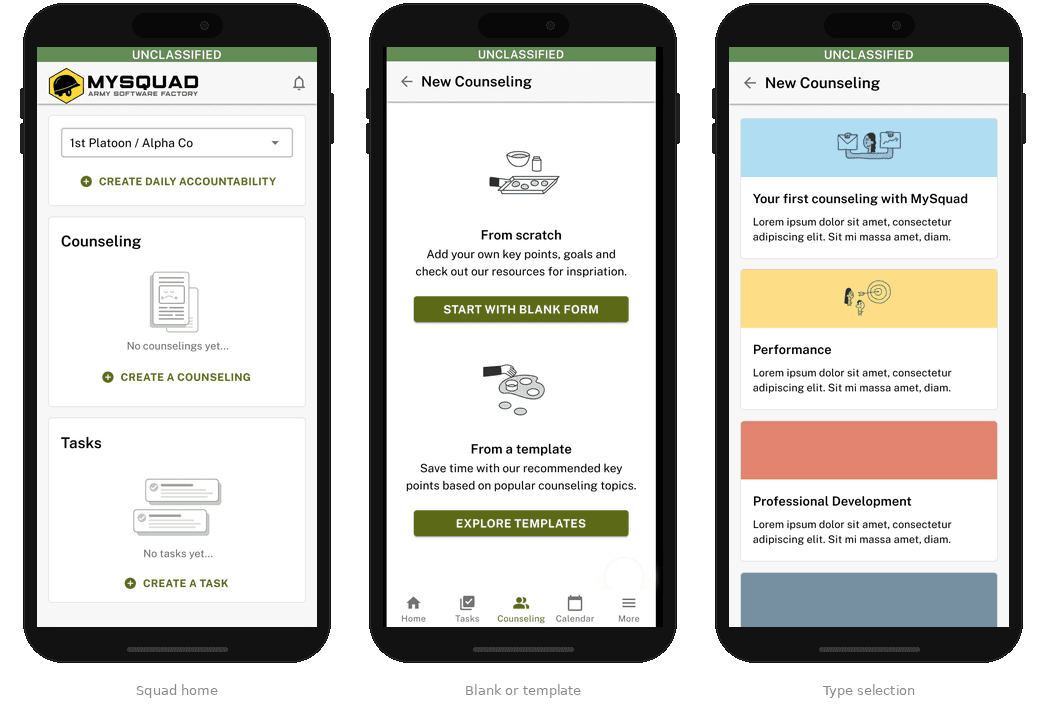
The counselor creates a new session from the home screen — choosing from a blank form, a template, or a specific counseling type. Everything scaffolds before data entry begins.
Session setup
Soldier selection & context
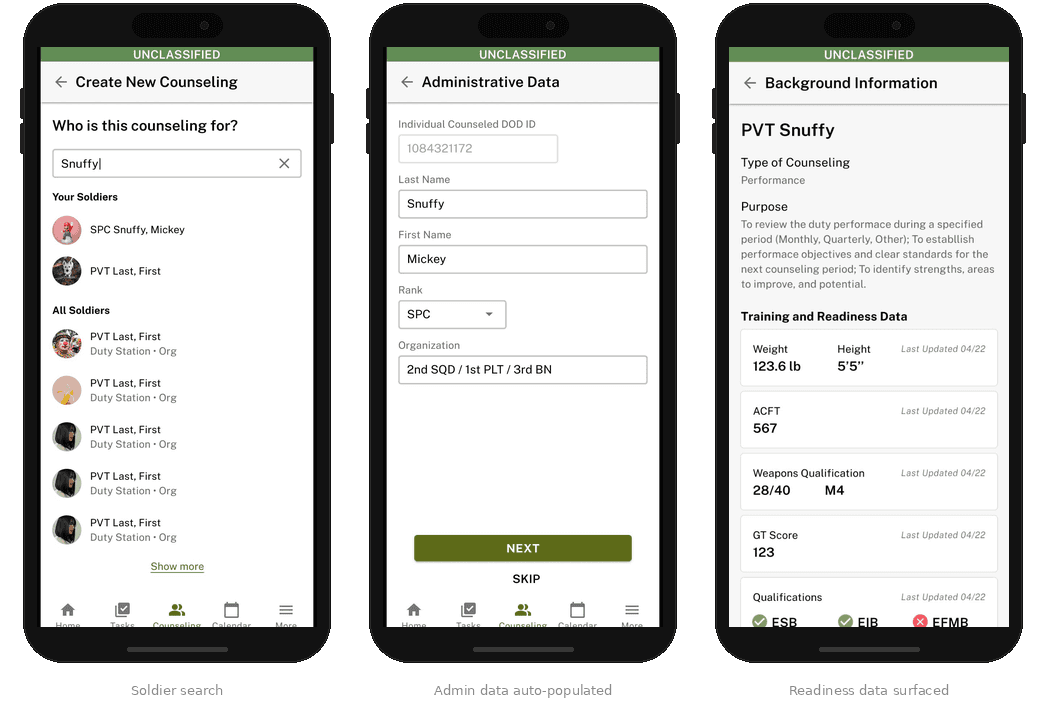
The counselor searches for and selects the Soldier. Administrative data auto-populates from the roster — no manual entry. Background information surfaces readiness metrics directly into the counseling context.
Documenting
Mirroring the DA 4856
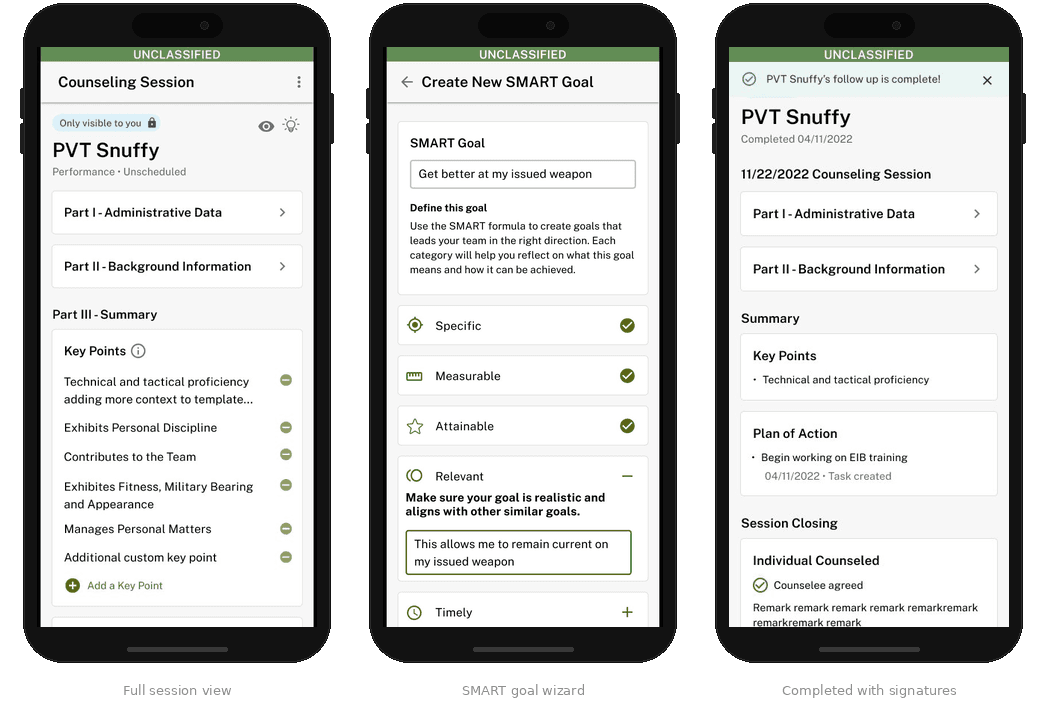
The full counseling session mirrors the DA 4856 structure exactly. Key points, plan of action, and session closing. A guided SMART goal wizard walks through each dimension so goals are structured, not vague.
Enforcing presence
The QR handshake
The most critical design decision was how we handled signatures. We needed to prove both parties were physically present — without DocuSign — within a government web app.
- 1
Counselor completes the session. The conversation happens in person.
- 2
Unique QR code generated. Tied to that session only.
- 3
Counselee scans on their device. Physical proximity required.
- 4
Both sign with custom signature block. Finger-drawn, built from scratch.
- 5
DA 4856 PDF generated. Every field compiled into the official form.
This wasn’t just a digital convenience — it was an integrity mechanism. The QR handshake made it impossible to complete a counseling asynchronously. No remote sign-offs. No post-hoc signatures. No checkbox counselings.
Squad accountability
Knowing where your people are
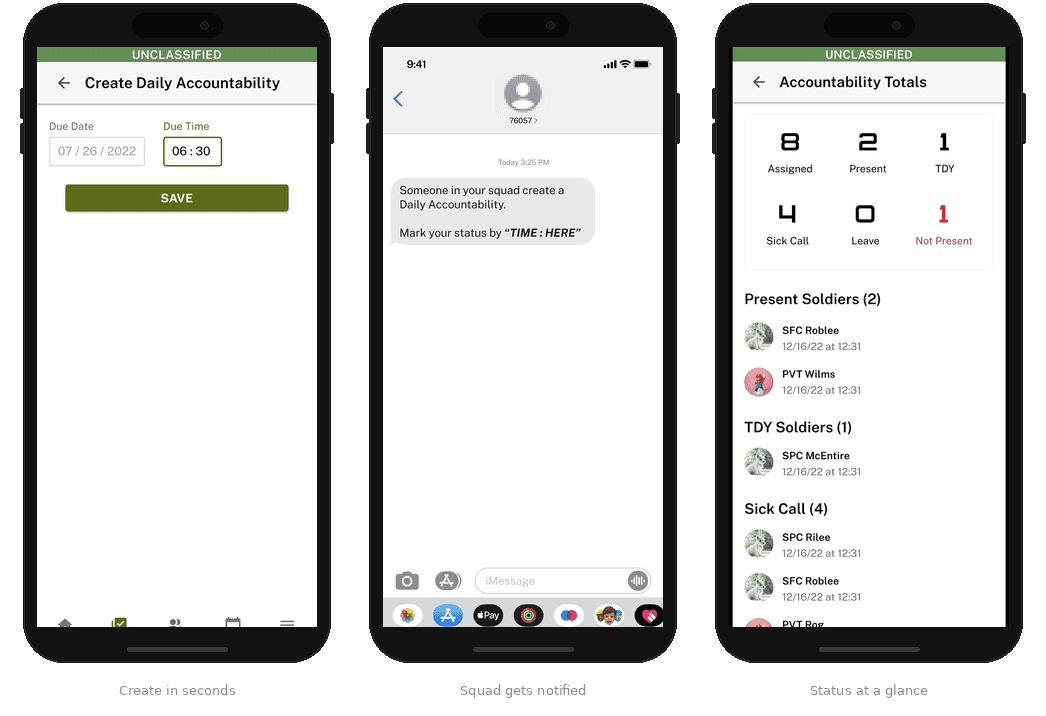
The second major feature addressed daily accountability — who’s present, who’s TDY, who’s on leave, who’s on sick call. Create an event, push notification, collect responses. Real-time totals ready to relay up the chain.
MySquad taught me that the hardest design problems aren’t about interfaces — they’re about values. The counseling workflow succeeded because we refused to treat digitization as a feature request. We treated it as a trust problem: how do you give leaders a better tool without giving bad actors an easier shortcut?
The answer was designing accountability into the system itself. The QR handshake wasn’t a technical flex — it was a direct response to what NCOs told us they were afraid of.
Working at the Army Software Factory shaped how I think about scale. Designing for every squad leader in the Army means designing for wildly different contexts, technical literacy levels, and leadership cultures.